Showing posts with label Personal. Show all posts

Monday, 2 June 2014

Religion is a disease of the mind?

Re: Religion Is A Disease of the Mind?

I recently read something online which linked religion to being a disease of the mind. I believe that religion and the concept of God hold many similarities to diseases of the mind but I would not say that they are the same. However, there’s very few other ways to describe how people, some of whom are presumably are intelligent, can be afflicted by something completely illogical. The concept of God has evolved to explain the unexplainable and provide people with a false sense of hope to support them in times of need.. It would seem that God is actually a beneficial construct of the human mind rather than a disease, which by definition is contradictory. I believe that people should strive for truth by and the notion of a God construct defies this search for truth; clouding many peoples view on the world. God interferes in people obtaining truth by creating a crutch whenever a situation beyond their control presents itself. Similarly, when an event that has us evade some horrible fate occurs, people are quick to credit God or another deity being as opposed to chance. The concept of God is for all intents and purposes harmless by itself. People are entitled to give credence to things as they see fit. Each to their own. However, the real disease aspect comes from organised religion; where a select few share their value system of what God is with others in a massively distributed system.  The most vulnerable are those of weak mind. The idea of coalescing and unifying rather than fending off the tide of peer pressure is far more appealing when confronted with such choices. Organised religion does have its role in society. From a spiritual sense, people need religion to engage in society when otherwise isolated. Even if the guy next to you has absolutely no relationship whether by interest or biology, sharing the same religion will provide a social bond. The most obvious danger though is when we return to the idea of how people manipulate the concept of God for their own ends, but this time in mass. This is the point of contention that is the most pernicious in religion. To sway the weak willed to a few’s bidding to me stinks of politics as usual. However, the masses being unable to desire for truth any longer now assault those who want to obtain truth. But it’s not a point of negotiation in this; they will impinge on others to suck them in and here the analogy of the disease is complete.
Below are a few videos that explain in depth the concept of religion being a disease of the mind.

Religion is a mental disorder:


Religion is a parasitic belief complex:


Religion is a mind disease:


It's makes no sense...


Contradictions


Saturday, 19 April 2014

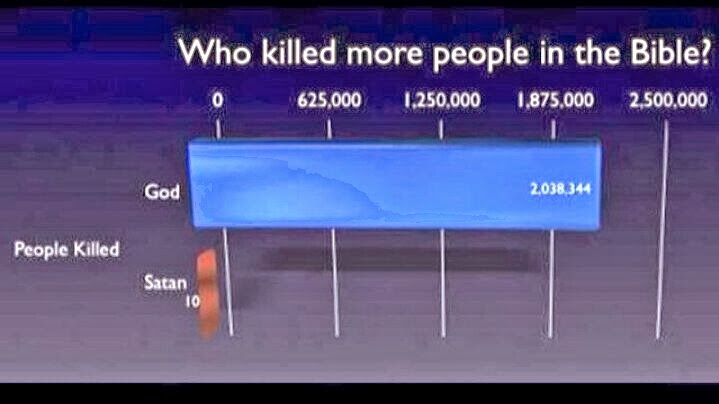
Visual Representation of Contradictions in the Bible

Contradictions In The Bible

This is an incomplete list. I realise that not everyone will see these as contradictions. It is subjective. All opinions are from my view, as an atheist.

Theological doctrines:

     1. God is satisfied with his works
         Gen 1:31
        God is dissatisfied with his works.  
         Gen 6:6
     2. God dwells in chosen temples
         2 Chron 7:12,16
        God dwells not in temples
         Acts 7:48
     3. God dwells in light
         Tim 6:16
        God dwells in darkness
         1 Kings 8:12/ Ps 18:11/ Ps 97:2
     4. God is seen and heard
         Ex 33:23/ Ex 33:11/ Gen 3:9,10/ Gen 32:30/ Is 6:1/
          Ex 24:9-11
        God is invisible and cannot be heard
         John 1:18/ John 5:37/ Ex 33:20/ 1 Tim 6:16
     5. God is tired and rests
         Ex 31:17
        God is never tired and never rests
         Is 40:28
     6. God is everywhere present, sees and knows all things
         Prov 15:3/ Ps 139:7-10/ Job 34:22,21
        God is not everywhere present, neither sees nor knows all      
        things
         Gen 11:5/ Gen 18:20,21/ Gen 3:8
     7. God knows the hearts of men
         Acts 1:24/ Ps 139:2,3
        God tries men to find out what is in their heart
         Deut 13:3/ Deut 8:2/ Gen 22:12
     8. God is all powerful
         Jer 32:27/ Matt 19:26
       God is not all powerful
         Judg 1:19
     9. God is unchangeable
         James 1:17/ Mal 3:6/ Ezek 24:14/ Num 23:19
        God is changeable
         Gen 6:6/ Jonah 3:10/ 1 Sam 2:30,31/ 2 Kings 20:1,4,5,6/ 
          Ex 33:1,3,17,14
     10. God is just and impartial
          Ps 92:15/ Gen 18:25/ Deut 32:4/ Rom 2:11/ Ezek 18:25
         God is unjust and partial
          Gen 9:25/ Ex 20:5/ Rom 9:11-13/ Matt 13:12
     11. God is the author of evil
          Lam 3:38/ Jer 18:11/ Is 45:7/ Amos 3:6/ Ezek 20:25
         God is not the author of evil
          1 Cor 14:33/ Deut 32:4/ James 1:13
     12. God gives freely to those who ask
          James 1:5/ Luke 11:10
         God withholds his blessings and prevents men from receiving    
         them
          John 12:40/ Josh 11:20/ Is 63:17
     13. God is to be found by those who seek him
          Matt 7:8/ Prov 8:17
         God is not to be found by those who seek him
          Prov 1:28
     14. God is warlike
          Ex 15:3/ Is 51:15
         God is peaceful
          Rom 15:33/ 1 Cor 14:33
     15. God is cruel, unmerciful, destructive, and ferocious
          Jer 13:14/ Deut 7:16/ 1 Sam 15:2,3/ 1 Sam 6:19
         God is kind, merciful, and good
          James 5:11/ Lam 3:33/ 1 Chron 16:34/ Ezek 18:32/ Ps 145:9/  
           1 Tim 2:4/ 1 John 4:16/ Ps 25:8
     16. God's anger is fierce and endures long
          Num 32:13/ Num 25:4/ Jer 17:4
         God's anger is slow and endures but for a minute
          Ps 103:8/ Ps 30:5
     17. God commands, approves of, and delights in burnt offerings,   
         sacrifices ,and holy days
          Ex 29:36/ Lev 23:27/ Ex 29:18/ Lev 1:9
         God disapproves of and has no pleasure in burnt offerings,    
         sacrifices, and holy days.
          Jer 7:22/ Jer 6:20/ Ps 50:13,4/ Is 1:13,11,12
     18. God accepts human sacrifices
          2 Sam 21:8,9,14/ Gen 22:2/ Judg 11:30-32,34,38,39
         God forbids human sacrifice
          Deut 12:30,31
     19. God tempts men
          Gen 22:1/ 2 Sam 24:1/ Jer 20:7/ Matt 6:13
         God tempts no man
          James 1:13
     20. God cannot lie
          Heb 6:18
         God lies by proxy; he sends forth lying spirits t deceive
          2 Thes 2:11/ 1 Kings 22:23/ Ezek 14:9
     21. Because of man's wickedness God destroys him
          Gen 6:5,7
         Because of man's wickedness God will not destroy him
          Gen 8:21
     22. God's attributes are revealed in his works.
          Rom 1:20
         God's attributes cannot be discovered
          Job 11:7/ Is 40:28
     23. There is but one God
          Deut 6:4
         There is a plurality of gods
          Gen 1:26/ Gen 3:22/ Gen 18:1-3/ 1 John 5:7
 

Moral Precepts

     24. Robbery commanded
          Ex 3:21,22/ Ex 12:35,36
         Robbery forbidden
          Lev 19:13/ Ex 20:15
     25. Lying approved and sanctioned
          Josh 2:4-6/ James 2:25/ Ex 1:18-20/ 1 Kings 22:21,22
         Lying forbidden
          Ex 20:16/ Prov 12:22/ Rev 21:8
     26. Hatred to the Edomite sanctioned
          2 Kings 14:7,3
         Hatred to the Edomite forbidden
          Deut 23:7
     27. Killing commanded
          Ex 32:27
         Killing forbidden
          Ex 20:13
     28. The blood-shedder must die
          Gen 9:5,6
         The blood-shedder must not die
          Gen 4:15
     29. The making of images forbidden
           Ex 20:4
         The making of images commanded
          Ex 25:18,20
     30. Slavery and oppression ordained
          Gen 9:25/ Lev 25:45,46/ Joel 3:8
         Slavery and oppression forbidden
          Is 58:6/ Ex 22:21/ Ex 21:16/ Matt 23:10
     31. Improvidence enjoyed
          Matt 6:28,31,34/ Luke 6:30,35/ Luke 12:3
         Improvidence condemned
          1 Tim 5:8/ Prov 13:22
     32. Anger approved
          Eph 4:26
         Anger disapproved
          Eccl 7:9/ Prov 22:24/ James 1:20
     33. Good works to be seen of men
          Matt 5:16
         Good works not to be seen of men
          Matt 6:1
     34. Judging of others forbidden
          Matt 7:1,2
         Judging of others approved
          1 Cor 6:2-4/ 1 Cor 5:12
      35. Christ taught non-resistance
          Matt 5:39/ Matt 26:52
         Christ taught and practiced physical resistance
          Luke 22:36/ John 2:15
     36. Christ warned his followers not to fear being killed
          Luke 12:4
         Christ himself avoided the Jews for fear of being killed
          John 7:1
     37. Public prayer sanctioned
          1 Kings 8:22,54, 9:3 
         Public prayer disapproved
          Matt 6:5,6
     38. Importunity in prayer commended
          Luke 18:5,7
         Importunity in prayer condemned
          Matt 6:7,8
     39. The wearing of long hair by men sanctioned
          Judg 13:5/ Num 6:5
         The wearing of long hair by men condemned
          1 Cor 11:14
     40. Circumcision instituted
          Gen 17:10
         Circumcision condemned
          Gal 5:2
     41. The Sabbath instituted
          Ex 20:8
         The Sabbath repudiated
          Is 1:13/ Rom 14:5/ Col 2:16
     42. The Sabbath instituted because God rested on the seventh day
          Ex 20:11
         The Sabbath instituted because God brought the Israelites     
         out of Egypt
          Deut 5:15
     43. No work to be done on the Sabbath under penalty of death
          Ex 31:15/ Num 15:32,36
         Jesus Christ broke the Sabbath and justified his disciples in  
         the same
          John 5:16/ Matt 12:1-3,5
     44. Baptism commanded
          Matt 28:19
         Baptism not commanded
          1 Cor 1:17,14
     45. Every kind of animal allowed for food.
          Gen 9:3/ 1 Cor 10:25/ Rom 14:14
         Certain kinds of animals prohibited for food.
          Deut 14:7,8
      46. Taking of oaths sanctioned
          Num 30:2/ Gen 21:23-24,31/ Gen 31:53/ Heb 6:13
         Taking of oaths forbidden
          Matt 5:34
     47. Marriage approved
          Gen 2:18/ Gen 1:28/ Matt 19:5/ Heb 13:4
         Marriage disapproved
          1 Cor 7:1/ 1 Cor 7:7,8
     48. Freedom of divorce permitted
          Deut 24:1/ Deut 21:10,11,14
         Divorce restricted
          Matt 5:32
     49. Adultery forbidden
          Ex 20:14/ Heb 13:4
         Adultery allowed
          Num 31:18/ Hos 1:2; 2:1-3
     50. Marriage or cohabitation with a sister denounced
          Deut 27:22/ Lev 20:17
         Abraham married his sister and God blessed the union
          Gen 20:11,12/ Gen 17:16
     51. A man may marry his brother's widow
          Deut 25:5
         A man may not marry his brother's widow
          Lev 20:21
     52. Hatred to kindred enjoined
          Luke 14:26
         Hatred to kindred condemned
          Eph 6:2/ Eph 5:25,29
     53. Intoxicating beverages recommended
          Prov 31:6,7/ 1 Tim 5:23/ Ps 104:15
         Intoxicating beverages discountenanced
          Prov 20:1/ Prov 23:31,32
     54. It is our duty to obey our rulers, who are God's ministers    
         and punish evil doers only
          Rom 13:1-3,6
         It is not our duty to obey rulers, who sometimes punish the   
         good and receive unto themselves damnation therefor
          Ex 1:17,20/ Dan 3:16,18/ Dan 6:9,7,10/ Acts 4:26,27/ 
           Mark 12:38,39,40/ Luke 23:11,24,33,35
     55. Women's rights denied
          Gen 3:16/ 1 Tim 2:12/ 1 Cor 14:34/ 1 Pet 3:6
         Women's rights affirmed
          Judg 4:4,14,15/ Judg 5:7/ Acts 2:18/ Acts 21:9
     56. Obedience to masters enjoined
          Col 3:22,23/ 1 Pet 2:18
         Obedience due to God only
          Matt 4:10/ 1 Cor 7:23/ Matt 23:10
     57. There is an unpardonable sin
          Mark 3:29
         There is not unpardonable sin
          Acts 13:39
 

Historical Facts

     58. Man was created after the other animals
          Gen 1:25,26,27
         Man was created before the other animals
          Gen 2:18,19
     59. Seed time and harvest were never to cease
          Gen 8:22
         Seed time and harvest did cease for seven years
          Gen 41:54,56/ Gen 45:6
     60. God hardened Pharaoh's heart
          Ex 4:21/ Ed 9:12
         Pharaoh hardened his own heart
          Ex 8:15
     61. All the cattle and horses in Egypt died
          Ex 9:3,6/ 14:9
       All the horses of Egypt did not die
          Ex 14:9
     62. Moses feared Pharaoh
          Ex 2:14,15,23; 4:19
         Moses did not fear Pharaoh
          Heb 11:27
     63. There died of the plague twenty-four thousand
          Num 25:9
         There died of the plague but twenty-three thousand
          1 Cor 10:8
     64. John the Baptist was Elias
          Matt 11:14
         John the Baptist was not Elias
          John 1:21
     65. The father of Joseph, Mary's husband was Jacob
          Matt 1:16
         The father of Mary's husband was Heli
          Luke 3:23
     66. The father of Salah was Arphaxad
          Gen 11:12
         The father of Salah was Cainan
          Luke 3:35,36
     67. There were fourteen generations from Abraham to David
          Matt 1:17
         There were but thirteen generations from Abraham to David
          Matt 1:2-6
     68. There were fourteen generations from the Babylonian captivity 
         to Christ.
          Matt 1:17
         There were but thirteen generations from the Babylonian       
         captivity to Christ
          Matt 1:12-16
     69. The infant Christ was taken into Egypt
          Matt 2:14,15,19,21,23
         The infant Christ was not taken into Egypt
          Luke 2:22, 39
     70. Christ was tempted in the wilderness
          Mark 1:12,13
         Christ was not tempted in the wilderness
          John 2:1,2
     71. Christ preached his first sermon on the mount
          Matt 5:1,2
         Christ preached his first sermon on the plain
          Luke 6:17,20
     72. John was in prison when Jesus went into Galilee
          Mark 1:14
         John was not in prison when Jesus went into Galilee
          John 1:43/ John 3:22-24
     73. Christ's disciples were commanded to go forth with a staff    
         and sandals
          Mark 6:8,9
         Christ's disciples were commanded to go forth with neither
         staffs nor sandals.
          Matt 10:9,10
     74. A woman of Canaan besought Jesus
          Matt 15:22
         It was a Greek woman who besought Him
          Mark 7:26
     75. Two blind men besought Jesus
          Matt 20:30
         Only one blind man besought Him
          Luke 18:35,38
     76. Christ was crucified at the third hour
          Mark 15:25
         Christ was not crucified until the sixth hour
          John 19:14,15
     77. The two thieves reviled Christ.
          Matt 27:44/ Mark 15:32
         Only one of the thieves reviled Christ
          Luke 23:39,40
     78. Satan entered into Judas while at supper
          John 13:27
         Satan entered into him before the supper
          Luke 22:3,4,7
     79. Judas committed suicide by hanging
          Matt 27:5
         Judas did not hang himself, but died another way
          Acts 1:18
     80. The potter's field was purchased by Judas
          Acts 1:18
         The potter's field was purchased by the Chief Priests
          Matt 27:6,7
     81. There was but one woman who came to the sepulchre
          John 20:1
         There were two women who came to the sepulchre
          Matt 28:1
     82. There were three women who came to the sepulchre
          Mark 16:1
         There were more than three women who came to the sepulchre
          Luke 24:10
     83. It was at sunrise when they came to the sepulchre
          Mark 16:2
        It was some time before sunrise when they came.
          John 20:1
     84. There were two angels seen by the women at the sepulchre, and 
         they were standing up.
          Luke 24:4
         There was but one angel seen, and he was sitting down.
          Matt 28:2,5
     85. There were two angels seen within the sepulchre.
          John 20:11,12
         There was but one angel seen within the sepulchre
          Mark 16:5
     86. Christ was to be three days and three nights in the grave
          Matt 12:40
         Christ was but two days and two nights in the grave
          Mark 15:25,42,44,45,46; 16:9>
     87. Holy ghost bestowed at pentecost
          Acts 1:8,5
         Holy ghost bestowed before pentecost
          John 20:22
     88. The disciples were commanded immediately after the            
         resurrection to go into Galilee
          Matt 28:10
         The disciples were commanded immediately after the            
         resurrection to go tarry at Jerusalem
          Luke 24:49
     89. Jesus first appeared to the eleven disciples in a room at     
         Jerusalem
          Luke 24:33,36,37/ John 20:19
         Jesus first appeared to the eleven on a mountain in Galilee
          Matt 28:16,17
     90. Christ ascended from Mount Olivet
          Acts 1:9,12
         Christ ascended from Bethany
          Luke 24:50,51
     91. Paul's attendants heard the miraculous voice, and stood       
         speechless
          Acts 9:7
         Paul's attendants heard not the voice and were prostrate
          Acts 26:14
     92. Abraham departed to go into Canaan
          Gen 12:5
         Abraham went not knowing where
          Heb 11:8
     93. Abraham had two sons
          Gal 4:22
         Abraham had but one son
          Heb 11:17
     94. Keturah was Abraham's wife
          Gen 25:1
         Keturah was Abraham's concubine
          1 Chron 1:32
     95. Abraham begat a son when he was a hundred years old, by the   
         interposition of Providence
          Gen 21:2/ Rom 4:19/ Heb 11:12
         Abraham begat six children more after he was a hundred years  
         old without any interposition of providence
          Gen 25:1,2
     96. Jacob bought a sepulchre from Hamor
          Josh 24:32
         Abraham bought it of Hamor
          Acts 7:16
     97. God promised the land of Canaan to Abraham and his seed       
         forever
          Gen 13:14,15,17; 17:8
         Abraham and his seed never received the promised land
          Acts 7:5/ Heb 11:9,13
     98. Goliath was slain by Elhanan
          2 Sam 21:19 *note, was changed in translation to be         
           correct.  Original manuscript was incorrect>
         The brother of Goliath was slain by Elhanan
          1 Chron 20:5
     99. Ahaziah began to reign in the twelfth year of Joram
          2 Kings 8:25
         Ahaziah began to reign in the eleventh year of Joram
          2 Kings 9:29
     100. Michal had no child
           2 Sam 6:23
          Michal had five children
           2 Sam 21:8
     101. David was tempted by the Lord to number Israel
           2 Sam 24:1
          David was tempted by Satan to number the people
           1 Chron 21:1
     102. The number of fighting men of Israel was 800,000; and of     
          Judah 500,000
           2 Sam 24:9
          The number of fighting men of Israel was 1,100,000; and of   
          Judah 470,000
           1 Chron 21:5
     103. David sinned in numbering the people
           2 Sam 24:10
          David never sinned, except in the matter of Uriah
          1 Kings 15:5
     104. One of the penalties of David's sin was seven years of       
          famine.
           2 Sam 24:13
          It was not seven years, but three years of famine
           1 Chron 21:11,12
     105. David took seven hundred horsemen
           2 Sam 8:4
          David took seven thousand horsemen
           1 Chron 18:4
     106. David bought a threshing floor for fifty shekels of silver
           2 Sam 24:24
          David bought the threshing floor for six hundred shekels of  
          gold
           1 Chron 21:25
     107. David's throne was to endure forever.
           Ps 89:35-37
          David's throne was cast down
           Ps 89:44
 

Speculative Doctrines

      108. Christ is equal with God
           John 10:30/ Phil 2:5
          Christ is not equal with God
           John 14:28/ Matt 24:36
     109. Jesus was all-powerful
           Matt 28:18/ John 3:35
          Jesus was not all-powerful
           Mark 6:5
     110. The law was superseded by the Christian dispensation
           Luke 16:16/ Eph 2:15/ Rom 7:6
          The law was not superseded by the Christian dispensation
           Matt 5:17-19
     111. Christ's mission was peace
           Luke 2:13,14
          Christ's mission was not peace
           Matt 10:34
     112. Christ received not testimony from man
           John 5:33,34
          Christ did receive testimony from man
           John 15:27
     113. Christ's witness of himself is true.
           John 8:18,14
          Christ's witness of himself is not true.
           John 5:31
     114. Christ laid down his life for his friends
           John 15:13/ John 10:11
          Christ laid down his life for his enemies
           Rom 5:10
     115. It was lawful for the Jews to put Christ to death
           John 19:7
          It was not lawful for the Jews to put Christ to death
           John 18:31
     116. Children are punished for the sins of the parents
           Ex 20:5
          Children are not punished for the sins of the parents
           Ezek 18:20
     117. Man is justified by faith alone
           Rom 3:20/ Gal 2:16/ Gal 3:11,12/ Rom 4:2
          Man is not justified by faith alone
           James 2:21,24/ Rom 2:13
     118. It is impossible to fall from grace
           John 10:28/ Rom 8:38,39
          It is possible to fall from grace
           Ezek 18:24/ Heb 6:4-6, 2 Pet 2:20,21
     119. No man is without sin
           1 Kings 8:46/ Prov 20:9/ Eccl 7:20/ Rom 3:10
         Christians are sinless
           1 John 3: 9,6,8
     120. There is to be a resurrection of the dead
           1 Cor 15:52/ Rev 20:12,13/ Luke 20:37/ 1 Cor 15:16
          There is to be no resurrection of the dead
           Job 7:9/ Eccl 9:5/ Is 26:14
     121. Reward and punishment to be bestowed in this world
           Prov 11:31
          Reward and punishment to be bestowed in the next world
           Rev 20:12/ Matt 16:27/ 2 Cor 5:10
     122. Annihilation the portion of all mankind
           Job 3: 11,13-17,19-22/ Eccl 9:5,10/ Eccl 3:19,20
          Endless misery the portion of all mankind
           Matt 25:46/ Rev 20:10,15/ Rev 14:11/ Dan 12:2
     123. The Earth is to be destroyed
           2 Pet 3:10/ Heb 1:11/ Rev 20:11
          The Earth is never to be destroyed
           Ps 104:5/ Eccl 1:4
     124. No evil shall happen to the godly
           Prov 12:21/ 1 Pet 3:13
          Evil does happen to the godly
           Heb 12:6/ Job 2:3,7
     125. Worldly good and prosperity are the lot of the godly
           Prov 12:21/ Ps 37:28,32,33,37/ Ps 1:1,3/ Gen 39:2/
            Job 42:12
          Worldly misery and destitution the lot of the godly
           Heb 11:37,38/ Rev 7:14/ 2 Tim 3:12/ Luke 21:17
     126. Worldly prosperity a reward of righteousness and a blessing
           Mark 10:29,30/ Ps 37:25/ Ps 112:1,3/ Job 22:23,24/
            Prov 15:6
          Worldly prosperity a curse and a bar to future reward
           Luke 6:20,24/ Matt 6:19,21/ Luke 16:22/ Matt 19:24/
            Luke 6:24
     127. The Christian yoke is easy
           Matt 11:28,29,30
          The Christian yoke is not easy
           John 16:33/ 2 Tim 3:12/ Heb 12:6,8
     128. The fruit of God's spirit is love and gentleness
           Gal 5:22
          The fruit of God's spirit is vengeance and fury
           Judg 15:14/ 1 Sam 18:10,11
     129. Longevity enjoyed by the wicked
           Job 21:7,8/ Ps 17:14/ Eccl 8:12/ Is 65:20
          Longevity denied to the wicked
           Eccl 8:13/ Ps 55:23/ Prov 10:27/ Job 36:14/ Eccl 7:17
     130. Poverty a blessing
           Luke 6:20,24/ Jams 2:5
          Riches a blessing
           Prov 10:15/ Job 22:23,24/ Job 42:12
          Neither poverty nor riches a blessing
           Prov 30:8,9
     131. Wisdom a source of enjoyment
           Prov 3:13,17
          Wisdom a source of vexation, grief and sorrow
           Eccl 1:17,18
     132. A good name is a blessing
           Eccl 7:1/ Prov 22:1
          A good name is a curse
           Luke 6:26
     133. Laughter commended
           Eccl 3:1,4/ Eccl 8:15
          Laughter condemned
           Luke 6:25/ Eccl 7:3,4
     134. The rod of correction a remedy for foolishness
           Prov 22:15
          There is no remedy for foolishness
           Prov 27:22
     135. A fool should be answered according to his folly
           Prov 26:5
       A fool should not be answered according to his folly
           Prov 26:4
     136. Temptation to be desired
           James 1:2
          Temptation not to be desired
           Matt 6:13
     137. Prophecy is sure
           2 Pet 1:19
          Prophecy is not sure
           Jer 18:7-10
     138. Man's life was to be one hundred and twenty years
           Gen 6:3/ Ps 90:10
          Man's life is but seventy years
           Ps 90:10
     139. The fear of man was to be upon every beast
           Gen 9:2
          The fear of man is not upon the lion
           Prov 30:30
     140. Miracles a proof of divine mission
           Matt 11:2-5/ John 3:2/ Ex 14:31
          Miracles not a proof of divine mission
           Ex 7:10-12/ Deut 13:1-3/ Luke 11:19
     141. Moses was a very meek man
            Num 12:3
          Moses was a very cruel man
           Num 31:15,17
     142. Elijah went up to heaven
           2 Kings 2:11
          None but Christ ever ascended into heaven
           John 3:13
     143. All scripture is inspired
           2 Tim 3:16
          Some scripture is not inspired
           1 Cor 7:6/ 1 Cor 7:12/ 2 Cor 11:17


Of course if you would like to do some more research on this you can look up the quotes yourself. If you do not own a bible then a good website you can use is www.kingjamesbibleonline.org 

Friday, 28 February 2014

What is Atheistic Satanism?

As a former Satanist, I never worshiped any devil.
Satanism is about putting yourself above those who are seen as 'inferior', or sheep. Satanists are about bettering themselves, loving those in your life with all of your heart, and to ignore the sheep. It is about self respect, and is VERY opposed to drug use, violence and everything else that has been portrayed as 'satanic'. Most Satanists I've met are very learned. Well read about all different religions. And they do NOT sit around trash talking Christianity. They respect those who have their own values and faith, as long as they don't shove it down our throats!
Satanism is a form of atheism, with a twist! Do not fear them!
I still believe firmly in the Satanic ways, however the Church of Satan has become very corrupt, and its values are being destroyed.

Thursday, 27 February 2014

Creationism Should NOT be Taught in Schools

Creationism is a pseudo-science.

It is rejected by the vast majority of the scientific community; in fact the only scientists who actually support it at all are those who have a personal interest in it supporting their own religious beliefs. Their opinions are biased. Creationism's evidence has failed to stand up to objective scientific scrutiny. Since Creationism doesn't qualify enough as a science (anymore than astrology or cryptozoology) to spend precious time teaching it in science class is stupid; there is no place for it.

Religious instruction has no place in public school. Public schools can't promote the teaching of one religion over others. The only place in a public school that Creationism would fit into the syllabus is a mythology class, yet Christians would protest it being taught in mythology alongside mythologies of other religions.

Creationists have basically taken an arrow that was shot 2000 years ago, and they are attempting to paint a bullseye around it where it fell.

Creationism is pseudo-science (I know that I have stated this previously but the fact that a pseudo-science is being taught in schools in 2014 angers me greatly). This isn't my opinion this is the official Supreme Court ruling in the 1987 case of Edwards vs Aguillard. We do not "balance" the teaching of science with nonsense. I know a lot of people believe in creationism, but that isn't an argument in its favour. The entire scientific community (that's the fancy way of saying people who know what the hell they are talking about) universally denouncing creationism as a religious ideology flatly contradicted by the scientific evidence. They really cannot argue against this.

Creationism is not true, so there really isn't any come back to that. There is no "OK its not true but..." no its nonsense so we don't teach it end of.

It's 2014 people, get yourselves together and get educated please.

10 Reasons Why God Doesn't Exist

There are 12 major religions: Baha'i, Buddhism, Christianity, Confucianism, Hinduism, Islam, Jainism, Judaism, Shinto, Sikhism, Taoism, and Zoroastrianism. There are multiple denominations for each religion such as Protestant and Orthodox etc for Christianity, but there are 12 dominant religions in the world.

Each person who has faith is 100% certain that their religion is correct and that all other religions are false (perhaps people who follow pluralism and inclusivism may accept other religions but they only truly follow one).

Let’s take Christians as an example. Christians have one religion- Christianity; they disregard every other religion as being false. So, Christians reject 11 out of 12 religions. I, as an atheist, just go one religion further. I disregard all 12 religions as I find them illogical.

Many people follow one religion as it is what they were indoctrinated with as a child. If one was born to Muslim parents then more likely than not they would be brought up to believe in the principle of Islam. If one was born to Jewish parents then they would probably be brought up to believe in Jewish principles. If you were born in a country with a strong religious influence, where you were not educated about science or other religions then I can say with 99.9% certainty you would follow the religion of your parents and those around you. The religion you have is, normally, the one you were indoctrinated with as a child.

I believe that there is no God, no demons and no Satan. You may wonder why I have these atheistic views, well, as a child I was brought up in a Christian community; I went to church regularly and I did not know that there was the possibility of having any other belief except my own. Suffice to say I was a Christian up until the age of 8 when I moved house, moved from my Christian school, and entered the world of reason. I was finally taught about science and also other faiths. I have since attended many religious, atheist and secularist lectures, I have studied the Bible and the teachings of the Qur’an. I am aware of all of the teachings and beliefs of Christianity and Islam and I know a fair bit about other religions too. My point is- I am educated on both sides of the spectrum. I know religious and atheist view points (of course I am simplifying here- I also know secularist and humanist etc views). I have chosen to be an atheist and a secularist because in my mind it makes a lot more sense than praying to an invisible being who resides all around us.

(I just thought of a humorous anecdote- when I was walking down the street the other day a creationist approached me, trying to convince me that his viewpoint was the correct viewpoint. He asked me how I believe the world and universe began. Of course, I said the big bang. His response? Well, he smiled and had an expression of victory on his face as he said “How do you know? Were you there?” “No, of course I was not there, it happened many billions of years ago; but there is a lot of evidence in support of its reality.” I replied. He then said “Yes, but you weren’t there. You do not know for sure.” I think, here, he just contradicted his own beliefs, because he said that if you have not witnessed something you should not believe it to be true. I am sure he has not witnessed God. Many religious people tell me that the world is enough evidence. This is incorrect. The world is not the product of intelligent design.)

I am aware that many people have religious belief as it provides them with comfort. To me this is absurd. How can talking to an invisible man (who loves everyone and has created everyone in his image, and forgives everyone of their sins, but still hates homosexuals, atheists and polytheistic people- I am here using the Christian deity as an example) make you feel comfort. If you seek comfort go and socialise with other human beings.

Anyway, here’s the main point of this post. Here are 10 reasons why I view God (any God, that is) to be false:

1. Prayers are never answered when verifiable things are prayed for.

Examples:

Christians have been praying for at least 50 years for their god to stop abortions, but their god has never stopped even one single abortion.

Christians have prayed for God to end famine and poverty. Needless to say he has not (If God is all-loving and all-caring then why would he subject innocent people to this abominable torture? It’s unnecessary).

2. God is a human construct. Before there were people to conceive of God, all there was in the Universe was all there was in the Universe - and, that is still all there is.

3. Even if such a being qualified to be called God exists, He/She/It would be so far beyond us as to make Him/Her/It incomprehensible to beings constrained by time and space. This would leave us with only our imaginary constructs of who and what such a being might be like.

Basically, the existence of God is dependent on the tenability of the definition of God being employed. If the definition of God is untenable, then that God does not exist. It really is that simple.

4. The question then becomes, who is qualified to define God? Definition necessarily implies limitation. And, no being qualified to be called God would have limits. Therefore, defining God becomes impossible in any provable sense. This renders the concept of God to be virtually worthless and meaningless. And, that renders the question of its existence equally worthless and meaningless...

The bible god has never been seen except in the fictional bible. The bible god is still a no show.....If the bible god existed, he obviously doesn't care anything at all about his silly followers.

What could a supernatural god be doing for 6,000 years? A real supernatural all powerful god could do anything with a though alone, yet the bible god can't take even one minute to appear on earth IN PERSON.?!!!!!!

5. God admitted multiple times in Exodus and Deuteronomy that he was a "jealous God." How can an all-perfect being be jealous? For jealousness, or envy, is an imperfection and attitude that, according to Christianity, should be righted.

6. "If a man commits adultery with the wife of his neighbour, both the adulterer and the adulteress shall be put to death. The man who lies with his father’s wife has uncovered his father’s nakedness; both of them shall be put to death; their blood is upon them. If a man lies with his daughter-in-law, both of them shall be put to death; they have committed perversion; their blood is upon them. If a man lies with a male as with a woman, both of them have committed an abomination; they shall be put to death; their blood is upon them. [Leviticus, chapter 20]"
[this is not made up, I have cross-referenced and Googled it and it IS written like that]
"When a slave-owner strikes a male or female slave with a rod and the slave dies immediately, the owner shall be punished. But if the slave survives for a day or two, there is no punishment; for the slave is the owner’s property." [Exodus, chapter 21]
"Let a woman learn in silence with full submission. I permit no woman to teach or to have authority over a man; she is to keep silent." [1 Timothy, chapter 2]

Here the basic idea is that even if God did exist, he'd be a jerk.

6. Christians blame free will for bad things that happen, but free will is a false premise.

Here’s why:

Christians claim their god is all powerful and all knowing. If that’s true then God knows in advance what all 6. 7 billion people on the planet will do... Before they do it. That seems very unlikely. If God was a computer I’m pretty sure that his server would overload.

If God is NOT all knowing then he has to sit back and wonder what each person will do next. In that case, God cannot be all knowing.

So either the bible God knows in advance what each of us will do, or he cannot be all knowing.

8. It is incumbent on Christians to actually prove this claim. I can claim that my imaginary green pet Baboon created everything. My claim has the same credibility as yours... Exactly zero... Unless one of us can actually produce our God in reality.

Neither one of us can do that because all Gods are make believe. All are imaginary.

9. Have you ever thought about how bizarre the crucifixion story is? Imagine the all-powerful, all-knowing creator of the universe sitting on his magnificent throne in heaven. He looks down onto earth and says to himself:

Those evil humans down on earth. I hate what they are doing. All this sin...

Since I am all-knowing I know exactly what the humans are doing and I understand exactly why they commit each sin. Since I created the humans in my own image and personally programmed human nature into their brains, I am the direct author of all of this sin. The instant I created them I knew exactly what would happen with every single human being right down to the nanosecond level for all eternity. If I didn't like how it was going to turn out, I could have simply changed them when I created them. And since I am perfect, I know exactly what I am doing. But ignore all that. I hate all these people doing exactly what I perfectly designed them to do and knew they would do from the moment I created them. I HATE IT! I tried killing all the humans and animals once in the flood. That certainly did not fix the problem.

So here's what I am going to do. I will artificially inseminate a virgin. She will give birth to an incarnated version of me. The humans will eventually crucify and kill the incarnated me. That, finally, will make me happy. Yes, sending myself down and having the humans crucify me -- that will satisfy me. I feel much better now.

It makes no sense, does it? Why would an all-knowing being need to have humans kill himself (Jesus is God, after all) to make himself happy? Especially since it is a perfect God who set the whole thing in motion exactly the way he wanted it? The whole story of the crucifixion is absurd from top to bottom if you actually stop to think about it.

If you believe the story of Jesus, Jesus clearly knew that he is God. In John chapter 14, verse 8 we find this:

Philip said to him, "Lord, show us the Father, and we shall be satisfied." Jesus said to him, "Have I been with you so long, and yet you do not know me, Philip? He who has seen me has seen the Father."

So it makes you wonder about Jesus' famous lamentation in Matthew 27:46:

About the ninth hour Jesus cried out in a loud voice, "Eloi, Eloi, lama sabachthani?"—which means, "My God, my God, why have you forsaken me?"

Since Jesus is God, what he really must have meant is: "Myself, myself, why have I forsaken me?" Which of course makes absolutely no sense.

The reason why the crucifixion makes no sense is because God is imaginary.

10. If you are a Christian who believes in the power of prayer, here is a very simple experiment that will show you something very interesting about your faith.

Take a coin out of your pocket. Now pray sincerely to Ra:

Dear Ra, almighty sun god, I am going to flip this ordinary coin 50 times, and I am asking you to cause it to land heads-side-up all 50 times. In Ra's name I pray, Amen.

Now flip the coin. Chances are that you won't get past the fifth or sixth flip and the coin will land tails.

What does this mean? Most people would look at this data and conclude that Ra is imaginary. We prayed to Ra, and Ra did nothing. We can prove that Ra is imaginary by using statistical analysis. If we flip the coin thousands of times, praying to Ra each time, we will find that the coin lands heads or tails in exact correlation with the normal laws of probability. Ra has absolutely no effect on the coin no matter how much we pray.

Even if we find a thousand of Ra's most faithful believers and ask them to do the praying/flipping, the results will be the same.

Therefore, as rational people, we conclude that Ra is imaginary. We look at Ra in the same way that we look at Leprechauns, Mermaids, Santa and so on. We know that people who believe in Ra are delusional.

Now let's try the experiment again, but this time let's pray to Jesus Christ instead of Ra. Pray sincerely to Jesus like this:

Dear Jesus, I know that you exist and I know that you hear and answer prayers as you promise in the Bible. I am going to flip this ordinary coin 50 times, and I am asking you to cause it to land heads-side-up all 50 times. In Jesus' name I pray, Amen.

Now flip the coin. Once again, after the fifth or sixth flip, the coin will land tails.

If we flip the coin thousands of times, praying to Jesus each time, we will find that the coin lands heads or tails in exact correlation with the normal laws of probability. We can gather together a group of Jesus' most pious followers to do the praying and the result will be the same. Jesus will have zero effect on the coin.

This makes complete sense. It is not like there are two laws of probability -- one for Christians who pray and the other for non-Christians. We all know that. There is only one law of probability because prayers have zero effect. That goes for all prayers. Jesus has no effect on our planet no matter how much we pray. We can prove that conclusively using statistical analysis.

If you are a Christian, watch what is happening inside your mind right now. The data is absolutely identical in both experiments. With Ra you looked at the data rationally and concluded that Ra is imaginary. But with Jesus... something else will happen. In your mind, you are already coming up with a thousand rationalizations to explain why Jesus did not answer your prayers:

It is not his will

He doesn't have time

I didn't pray the right way

I am not worthy

I do not have enough faith

I cannot test the Lord like this

It is not part of Jesus' plan for me

And on and on and on...

One rationalization that you may find yourself developing is particularly interesting. You may say to yourself: “Well, of course Jesus doesn’t answer me when I pray about a coin toss, because it is too trivial." Where did this rationalization come from? If you read what Jesus says about prayer in the Bible (see Proof #1), Jesus does not ever say, "don't pray to me about coin tosses." Jesus clearly says he will answer your prayers, and he puts no boundaries on what you may pray for. You invented this rationalization out of thin air.

If you are a Christian who is offended by the notion of praying about a coin toss, then let's try this instead. Get down on your knees right now and pray as follows:

"Dear Jesus, son of God, the almighty, all-powerful, all-loving creator of the universe, we pray to you to cure every case of cancer on this planet tonight. Please hear our heartfelt, unselfish, non-materialistic prayer and fulfil your promises in Matthew 7:7, Matthew 17:20, Matthew 21:21, Mark 11:24, John 14:12-14, Matthew 18:19, Mark 9:23, Luke 1:37, James 5:15-16 and many other places. We pray knowing that when you answer this prayer, it will glorify God and help millions of people in remarkable ways. In your name we pray, Amen."

Will every case of cancer be gone tomorrow? Of course not. If you are a believer, you can create dozens of rationalizations for this unanswered prayer. But that does not change the reality of the situation. There is zero effect from praying, and it does not matter what you pray for.

You are an expert at creating rationalizations for Jesus. The reason you are an expert is because Jesus does not answer any of your prayers (see Proof #2). The reason why Jesus does not answer any of your prayers is because Jesus is imaginary. We can find dozens of pieces of evidence to demonstrate that the Christian story is imaginary. Start with Proof #1 to see them all.

Wednesday, 26 February 2014

Atheist Images

Atheist census- numbers matter.

Atheist census- numbers matter, sign the census now by clicking the link and answering some demographical questions.

Atheist (and other related) Terms:

Agnosticism:

"Agnosticism is the position of believing that knowledge of the existence or non-existence of God is impossible. It is often put forth as a middle ground between theism and atheism. Understood this way, agnosticism is skepticism regarding all things theological. The agnostic holds that human knowledge is limited to the natural world, that the mind is incapable of knowledge of the supernatural. Understood this way, an agnostic could also be a theist or an atheist. The former is called a fideist, one who believes in God purely on faith. The latter is sometimes accused by theists of having faith in the non-existence of God, but the accusation is absurd and the expression meaningless. The agnostic atheist simply finds no compelling reason to believe in God." - Skeptic's Dictionary

"Agnosticism may simply be the state of not knowing whether any gods exist or not, but people can take this position for different reasons and apply it in different ways. These differences then create variations in the ways in which one can be an agnostic. It is thus possible to separate agnostics in two groups, labeled strong agnosticism and weak agnosticism as analogs to strong atheism and weak atheism. If someone is a weak agnostic, they state only that they do not know if any gods exist or not. The possibility of some theoretical god or some specific god existing is not excluded. The possibility of someone else knowing for sure if some god exists or not is also not excluded. This is a very simple and general position and it is what people often think of when they think of agnosticism. Strong agnosticism goes just a bit further. If someone is a strong agnostic, they don't merely claim that they don't know if any gods exist; instead, they also claim that no one can or does know if any gods exist. Whereas weak agnosticism is a position that only describes the state of knowledge of one person, strong agnosticism makes a statement about knowledge and reality themselves." - Austin Cline, About.com

Atheism:

"The term atheism comes from the Greek word atheos, meaning godless. Atheos is derived from a, meaning "without," and theos, meaning "deity"." - The Atheist Empire

"An Atheist has no religious belief. An Atheist does not believe in a god or gods, or other supernatural entities...We are not a "religion." The concept of an agency outside of nature with the ability to reach into natural law and control events is supernaturalism, the foundation of any religion. Belief in the existence of that agency is based on faith. An Atheist has no specific belief system. We accept only that which is scientifically verifiable. Since god concepts are unverifiable, we do not accept them. " - American Atheists

"Atheism is commonly divided into two types: strong atheism and weak atheism. Although only two categories, this distinction manages to reflect the broad diversity which exists among atheists when it comes to their positions on the existence of gods. Weak atheism, also sometimes referred to as implicit atheism, is simply another name for the broadest and most general conception of atheism: the absence of belief in any gods. A weak atheist is someone who lacks theism and who does not happen to believe in the existence of any gods - no more, no less. This is also sometimes called agnostic atheism because most people who self-consciously lack belief in gods tend to do so for agnostic reasons. Strong atheism, also sometimes referred to as explicit atheism, goes one step further and involves denying the existence of at least one god, usually multiple gods, and sometimes the possible existence of any gods at all. Strong atheism is sometimes called "gnostic atheism" because people who take this position often incorporate knowledge claims into it - that is to say, they claim to know in some fashion that certain gods or indeed all gods do not or cannot exist." - Atheism.com

Brights:

"The defining attribute of the person (a Bright)...is this: possessing a worldview that is naturalistic..."Brights" include the many and various types of persons whose perspective, values, ethics, and conduct derive from a naturalistic worldview, free of any supernatural sorts of entities or forces. While they differ in the particulars of their outlook, they have this commonality...The simple noun term, "bright" has the potential to gather under the same umbrella all persons who hold a naturalistic worldview, whether or not they see themselves part of any of the various organizations in the communities of reason." - The Brights' Net

Freethinkers:

"free-think-er n. A person who forms opinions about religion on the basis of reason, independently of tradition, authority, or established belief. Freethinkers include atheists, agnostics and rationalists. No one can be a freethinker who demands conformity to a bible, creed, or messiah. To the freethinker, revelation and faith are invalid, and orthodoxy is no guarantee of truth." - Freedom From Religion Foundation, Inc.

"The concept of freethought refers to the process of making decisions and arriving at beliefs without relying solely upon tradition, dogma, or the opinions of authorities. Usually the context of this is only in religion, although a person can be a freethinker in other areas as well. In place of tradition or dogma, freethinkers insist upon using reason, logic, and evidence as the bases for forming reasonable and justified beliefs. Superstition is rejected in favor of science. Most freethinkers are also atheists, although that is not required. It is possible to be an atheist without also being a freethinker, or to be a freethinker without also being an atheist." - Austin Cline, Glossary of Religion & Philosophy at About.com

Humanism:

"As Kurt Vonnegut succinctly described: being a Humanist means trying to behave decently without expectation of rewards or punishment after you are dead. Humanism is a progressive lifestance that, without supernaturalism, affirms our ability and responsibility to lead ethical lives of personal fulfillment that aspire to the greater good of humanity." - American Humanist Association

"Humanism is a philosophy of life inspired by humanity and guided by reason. Humanists think that science and reason provide the best basis for understanding the world around us. Humanists believe that moral values are properly founded on human empathy and scientific understanding. Humanists see no convincing evidence for gods, the supernatural, or life after death. Humanists believe we must live this life on the basis that it is the only life we'll have -- that, therefore, we must make the most of it for ourselves, each other, and our world. Humanist philosophies have arisen separately in many different cultures over many thousands of years. Today, even though most have never assigned a label to their most cherished ideas about life, knowledge, ethics, purpose, and the universe, a significant portion of society shares this non-religious approach to life. Whether or not they use the term humanism, tens of millions of Americans and hundreds of millions of people around the world agree with the humanist philosophy of living a happy and productive life based on reason and compassion." - Institute for Humanist Studies

"Secular Humanism is a way of thinking and living that aims to bring out the best in people so that all people can have the best in life. Secular humanists reject supernatural and authoritarian beliefs. They affirm that we must take responsibility for our own lives and the communities and world in which we live. Secular humanism emphasizes reason and scientific inquiry, individual freedom and responsibility, human values and compassion, and the need for tolerance and cooperation." - Council for Secular Humanism

Naturalism:

"Naturalism is a metaphysical theory which holds that all phenomena can be explained mechanistically in terms of natural (as opposed to supernatural) causes and laws. Naturalism posits that the universe is a vast machine or organism, devoid of general purpose and indifferent to human needs and desires...naturalism neither denies nor affirms the existence of God, either as transcendent or immanent. However, naturalism makes God an unnecessary hypothesis and essentially superfluous to scientific investigation. Reference to moral or divine purposes has no place in scientific explanations. On the other hand, the scope of science is limited to explanation of empirical phenomena without reference to forces, powers, influences, etc., which are supernatural." - The Skeptic's Dictionary

"The hypothesis that the physical universe is a 'closed system' in the sense that nothing is neither a part nor a product of it can affect it. So naturalism entails the nonexistence of all supernatural beings, including the theistic god." - Paul Draper, as posted on The Secular Web

"Naturalistic - not only do we hold that evidence for the supernatural has not been convincingly demonstrated, but that belief in the supernatural has lead to a great deal of misery for humanity and needs to be rejected and replaced with critical inquiry, accountability, and science." - Secular Student Alliance

Rationalism:

"Rationalism: The mental attitude which unreservedly accepts the supremacy of reason and aims at establishing a system of philosophy and ethics verifiable by experience, independent of all arbitrary assumptions or authority." - American Rationalist

The doctrine of rationalism holds that the source of knowledge is reason and logic. This is usually contrasted with the idea that faith, revelation and religion are also valid sources of knowledge and verification. - Austin Cline, Glossary of Religion & Philosophy at About.com

Skepticism:

"Skepticism has a long historical tradition dating back to ancient Greece when Socrates observed: "All I know is that I know nothing." But this is not a practical position to take. Modern skepticism is embodied in the scientific method, that involves gathering data to formulate and test naturalistic explanations for natural phenomena. A claim becomes factual when it is confirmed to such an extent it would be reasonable to offer temporary agreement. But all facts in science are provisional and subject to challenge, and therefore skepticism is a method leading to provisional conclusions. Some claims, such as water dowsing, ESP, and creationism, have been tested (and failed the tests) often enough that we can provisionally conclude that they are false. Other claims, such as hypnosis and chaos theory, have been tested but results are inconclusive so we must continue formulating and testing hypotheses and theories until we can reach a provisional conclusion. The key to skepticism is to continuously and vigorously apply the methods of science to navigate the treacherous straits between "know nothing" skepticism and "anything goes" credulity." - Michael Shermer, as posted by the Skeptic Society

"Philosophical Skepticism is a critical attitude which systematically questions the notion that absolute knowledge and certainty are possible, either in general or in particular fields. Philosophical Skepticism is opposed to philosophical dogmatism, which maintains that a certain set of positive statements are authoritative, absolutely certain and true. Philosophical Skepticism should be distinguished from ordinary skepticism, where doubts are raised against certain beliefs or types of beliefs because the evidence for the particular belief or type of belief is weak or lacking. Ordinary skeptics are not credulous or gullible. They don't take things on trust, but must see the evidence before believing. Ordinary skeptics doubt the miraculous claims of religions, the claims of alien abductions, the claims of psychoanalysis, etc. But they do not necessarily doubt that certainty or knowledge is possible. Nor do they doubt these things because of systematic arguments that undermine all knowledge claims." - Skeptic's Dictionary

Universism:

"Universism is the world's first rational religion...We celebrate faith in reason, inspiration in nature, and hope in progress...A Universist an individual who applies personal reason and experience to the fundamental questions of human existence, derives inspiration from the natural uncertainty of the human state, and denies the validity of revelation, faith and dogma." - United Universists

Secularism:

Secularism is a principle that involves two basic propositions. The first is the strict separation of the state from religious institutions. The second is that people of different religions and beliefs are equal before the law.

Separation of religion from state

The separation of religion and state is the foundation of secularism. It ensures that religious groups don't interfere in affairs of state, and makes sure the state doesn't interfere in religious affairs.

In the United Kingdom there are officially two state recognised Christian denominations – the Church of England and the Presbyterian Church of Scotland. The Queen is both head of state and Supreme Governor of the Church of England. There is no established church in Northern Ireland or Wales but the 26 unelected bishops of the Church of England who sit in the House of Lords influence laws that affect the whole of the UK.

Christianity is one major influence among many that shape our current ways of life; we are a nation of many denominations and religions and large sectors of the population do not hold, or practise, religious beliefs.

If Britain were truly a secular democracy, political structures would reflect the reality of changing times by separating religion from the state.

Secularism protects both believers and non-believers

Secularism seeks to ensure and protect freedom of religious belief and practice for all citizens. Secularism is not about curtailing religious freedoms; it is about ensuring that the freedoms of thought and conscience apply equally to all believers and non-believers alike.

Religious Freedom

Secularism seeks to defend the absolute freedom of religious and other belief, and protect the right to manifest religious belief insofar as it does not impinge disproportionately on the rights and freedoms of others. Secularism ensures that the right of individuals to freedom of religion is always balanced by the right to be free from religion.

Secularism is about democracy and fairness

In a secular democracy all citizens are equal before the law and parliament. No religious or political affiliation gives advantages or disadvantages and religious believers are citizens with the same rights and obligations as anyone else.

Secularism champions human rights above discriminatory religious demands. It upholds equality laws that protect women, LGBT people and minorities. These equality laws ensure that non-believers have the same rights as those who identify with a religious or philosophical belief.

Equal access to public services

We all share hospitals, schools, the police and the services of local authorities. It is essential that these public services are secular at the point of use so that no-one is disadvantaged or denied access on grounds of religious belief (or non-belief.) All state-funded schools should be non-religious in character, with children being educated together regardless of their parents' religion. When a public body grants a contract for the provision of services to an organisation affiliated to a particular religion or belief, such services must be delivered in a neutral manner, with no attempt to promote the ideas of that faith group.

Secularism is not atheism

Atheism is a lack of belief in gods. Secularism simply provides a framework for a democratic society. Atheists have an obvious interest in supporting secularism, but secularism itself does not seek to challenge the tenets of any particular religion or belief, neither does it seek to impose atheism on anyone.

Secularism is simply a framework for ensuring equality throughout society – in politics, education, the law and elsewhere, for believers and non-believers alike.

Secularism protects free speech and expression

Religious people have the right to express their beliefs publicly but so do those who oppose or question those beliefs. Religious beliefs, ideas and organisations must not enjoy privileged protection from the right to freedom of expression. In a democracy, all ideas and beliefs must be open to discussion. Individuals have rights, ideas do not.

Secularism is the best chance we have to create a society in which people of all religions or none can live together fairly and peacefully.
- The National Secular Society